
Neoclassical Interior Design: Order, Symmetry, and Grandeur
Neoclassical interior design with Greek and Roman inspiration, symmetry, and refined proportions. See classical grandeur adapted for contemporary homes.
RoomRenovation.AI Team
Updated March 23, 2026

Neoclassical interior design is the conscious revival of Greek and Roman architectural principles applied to the interiors of homes and public buildings. It emerged as a defining movement in the late eighteenth century — when excavations at Pompeii and Herculaneum brought ancient design back into popular consciousness — and it has never fully gone away. In its 2026 expression, neoclassicism offers something that few contemporary styles provide: order, permanence, and a visual confidence rooted in millennia of accumulated architectural knowledge.
The Foundational Principles: Order and Proportion
Classical architecture is above all a system of proportional relationships. The Greeks established that certain ratios — between column diameter and height, between opening width and arch height, between room width and ceiling height — produce spaces that feel simultaneously grand and harmonious. Neoclassical interior design applies these principles at a domestic scale:
- Symmetry: Matched pairs of windows, flanking bookcases, and balanced furniture arrangements are the neoclassical default. Asymmetry requires deliberate justification.
- Hierarchy: Rooms are organized around a dominant focal point — typically a fireplace, an architectural niche, or a tall window. Secondary elements are arranged in clear subordination to this focal point.
- Proportion: Ceiling heights, window sizes, and door surrounds are scaled in relationship to each other and to the human figure. Undersized doors in oversized rooms or low ceilings with grand architectural details produce visual discomfort that is difficult to articulate but immediately felt.
Color in Neoclassical Interiors
The neoclassical palette is simultaneously restrained and rich. White — in its many warm variants — dominates because it references the white marble and plaster of classical antiquity. But neoclassical rooms are rarely cold:
- Wall color: Deep stone whites, warm ivory, pale gray-blues (Farrow & Ball's Borrowed Light or Mizzle), and pale celadon greens. Gold and deep terracotta appear in more dramatic interpretations.
- Architectural woodwork: Painted bright white (not off-white) to create crisp contrast against wall color.
- Accent tones: Gilded gold hardware and picture frames, deep navy or burgundy upholstery, warm Sienna and umber in rugs and art.

Architectural Details That Define Neoclassical Design
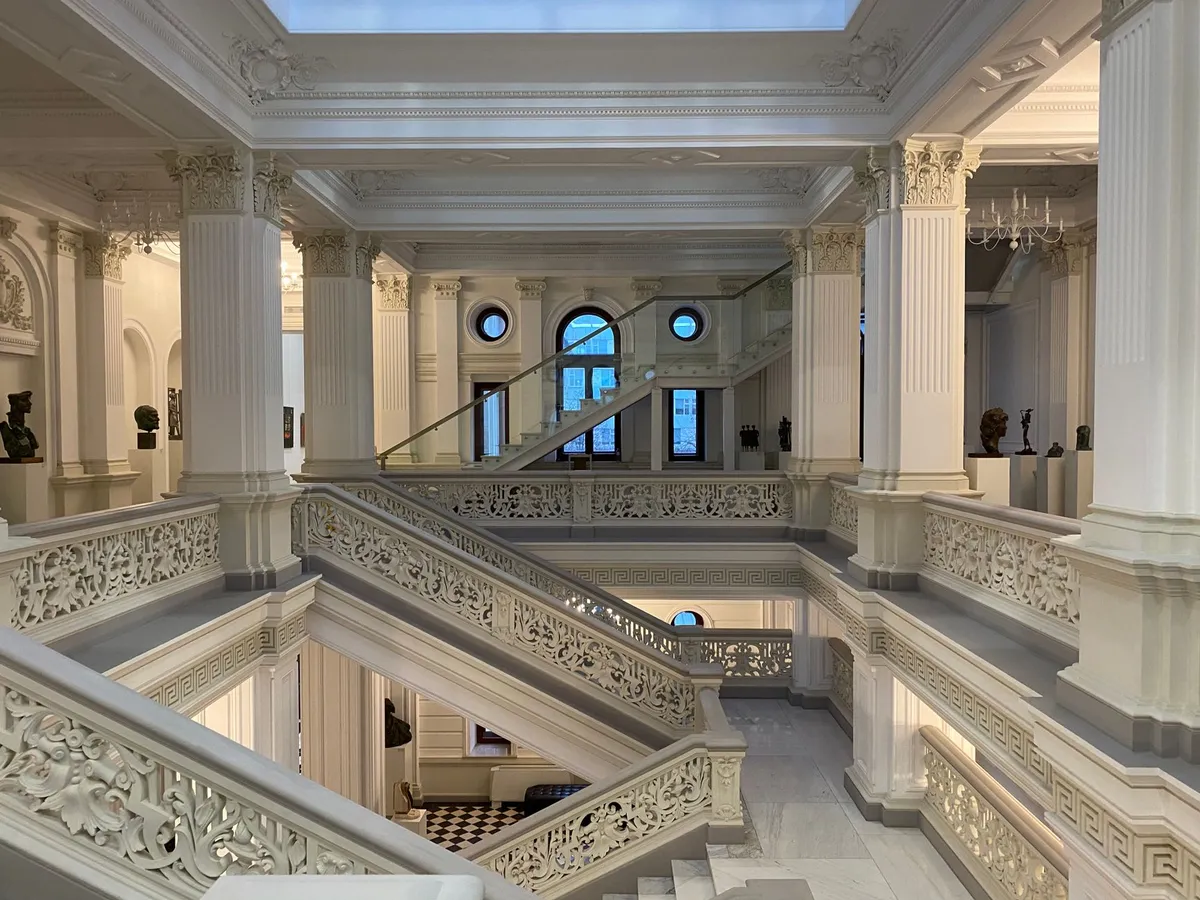
Neoclassical architecture lives in the details — the precise execution of cornices, moldings, columns, and pilasters that give classical rooms their character. In a residential setting:
Columns and Pilasters
Columns at doorways or between rooms were standard in late eighteenth-century neoclassical houses. Free-standing columns defining an entrance from a foyer, or pilasters (flat column-like projections) flanking a fireplace surround, are readily achievable with pre-fabricated architectural elements.
Cornice and Ceiling Decoration
Elaborate plaster cornices, dentil molding, egg-and-dart details, and coffered ceilings are all neoclassical signatures. In an existing home, these can be added via reproduction plaster or high-quality resin moldings. The investment is modest compared to the visual transformation.
Fireplace Surrounds
The neoclassical fireplace surround is often the room's defining feature. Carved marble or painted wood with classical motifs — fluted pilasters, a garland frieze, a projecting mantelshelf — provides the dominant focal point around which furniture is arranged symmetrically.
Door and Window Surrounds
Classical door surrounds feature pilasters, entablature (a horizontal beam above the door), and sometimes a broken pediment above. Window treatments in neoclassical rooms are formal: silk or linen drapery in floor-length panels, with a valance or cornice box above.
Neoclassical Furniture: Characteristics and Key Periods
Furniture in neoclassical rooms draws from three primary periods, each with distinct character:
- Adam Style (1760s–1790s, British): Robert Adam's refined, delicate neoclassicism. Satinwood furniture with painted decoration, tapered legs, oval and shield-back chair forms, and medallion motifs. Feminine and light in character.
- Empire Style (1804–1815, French/American): Bolder and heavier than Adam, Empire furniture features strong geometric forms, prominent brass ormolu mounts, dark mahogany or ebonized wood, and Egyptian-inspired motifs (sphinxes, lotus flowers). Military and imposing.
- Federal Style (1780–1820, American): The American adaptation of neoclassicism, blending British Adam style with French influences. Refined mahogany and satinwood, inlay decoration, and elliptical or shield-back forms.
In contemporary neoclassical rooms, mixing these periods thoughtfully is both acceptable and common. A French Empire sofa works with British Adam chairs if they share material and color register.
Art and Objects in Neoclassical Rooms
Classical rooms have specific approaches to art and object display:
- Portrait and landscape oil paintings: Large, gilt-framed oils are the natural wall art for neoclassical rooms. The frame is as important as the painting — an appropriately scaled carved gilt frame contributes more than an identically sized print in a modern frame.
- Sculpture and busts: Plaster, bronze, or marble busts of classical figures placed on columns or pedestals are period-appropriate and still available at reasonable cost through architectural salvage dealers.
- Symmetrical display: Objects on a mantelshelf, console table, or sideboard are arranged in matching pairs or strict bilateral symmetry. A candlestick on the left is matched by an identical candlestick on the right.
- Blue-and-white porcelain: Chinese export porcelain in blue and white was collected obsessively by eighteenth-century aristocrats and remains a neoclassical staple. Wedgwood's jasperware in pale blue with white bas-relief decoration is quintessentially neoclassical.
Contemporary Neoclassical: The 2026 Interpretation
Strict period recreation is museum territory. Contemporary neoclassical design borrows the structure — symmetry, proportion, architectural detail — while relaxing some of the more demanding historical requirements:
- Marble effect luxury vinyl tile instead of stone floors in rental properties
- Simplified molding profiles that suggest classical detail without elaborate carving
- Contemporary furniture with classical proportions — a sofa with tapered legs and a clean profile works in a neoclassical room
- Muted color palettes replacing the sometimes aggressive Empire-period color
The most successful contemporary neoclassical interiors have been described as "quiet luxury" — a quality that shares neoclassicism's commitment to proportion and fine materials without the theatrical grandeur of a period revival. Want to see how architectural details and neoclassical color palettes would transform your room? Try a free AI render or explore examples from homeowners who've tested the style.
Neoclassical vs. Similar Styles
- Traditional: Broader category that includes neoclassicism but also incorporates Gothic, Baroque, and Colonial Revival. Neoclassical is more specific and structurally rigorous.
- Hollywood Regency: Draws from neoclassicism but amplifies the glamour — lacquered surfaces, mirrored furniture, bold color. The showier sibling.
- Transitional: Blends neoclassical structure with contemporary simplicity. The most commercially popular current interpretation of classical design.

FAQ
Can neoclassical design work in a contemporary home without period architecture? Yes, but the architectural detail needs to be added. Pre-made cornice moldings, simple column surrounds at doorways, and an architecturally detailed fireplace surround can establish the classical vocabulary even in a new-build box. The furniture and color scheme then reinforce what the architecture introduces.
How does neoclassical differ from Greek Revival? Greek Revival is a specific subset of neoclassical that emphasizes Greek (rather than Roman) precedents — gable-end facades that evoke temple fronts, Doric or Ionic columns, trabeated (post-and-beam) rather than arched construction. Neoclassical is the broader category that includes Greek Revival, Roman Revival, and Adam-style applications.
What flooring suits a neoclassical interior? Marble — real or high-quality engineered — is the classical ideal. Wide-plank hardwood in dark walnut or mahogany also reads appropriately. Large-format stone tiles in cream or pale gray work in contemporary neoclassical interpretations. Parquet (herringbone or basket-weave) in hardwood bridges classical and contemporary effectively.
Is neoclassical design appropriate for a small home? Classical proportions adapt surprisingly well to smaller rooms, provided the architectural detail is scaled correctly. A small room with a correctly scaled cornice, a well-proportioned fireplace, and symmetrical furniture arrangement reads as elegant rather than crowded. The key is not to miniaturize the detail — a cornice that's too small for the room looks timid. Use RoomRenovation.ai to visualize how classical elements scale in your actual space.
What's the typical cost range for a neoclassical interior refresh? Architectural work — adding cornice molding, a fireplace surround, and door surrounds — typically runs $3,000–$12,000 depending on material and complexity. Furniture for a neoclassical living room (sofa, pair of chairs, occasional tables) runs $5,000–$25,000 depending on whether you source antiques, quality reproductions, or new pieces with classical lines. See our living room renovation cost guide for detailed breakdowns.